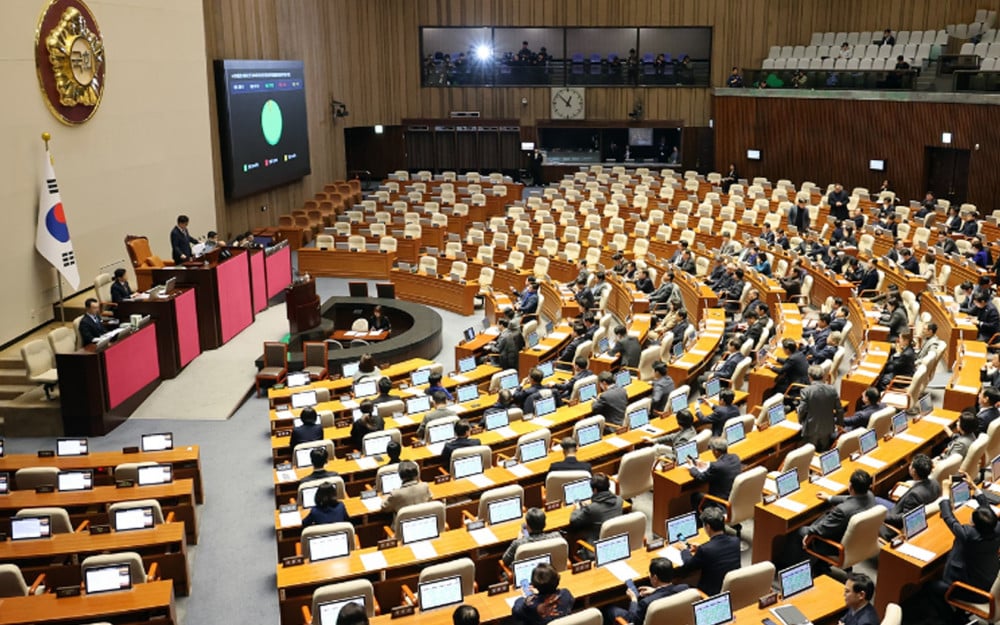
The National Assembly passed the so-called “Anti–False and Manipulated Information Act”—a revision to the Information and Communications Network Act—led by the ruling Democratic Party of Korea. The vote tally stood at 170 in favor, three against, and four abstentions, with 177 lawmakers present. The main opposition People Power Party boycotted the vote.
The bill had been delayed a day earlier after the People Power Party invoked a filibuster following its introduction on the 23rd. After the unlimited debate was formally ended, the bill was brought to a vote and passed during the plenary session.
The Democratic Party explained that the legislation aims to ban the circulation of false and manipulated information on information and communications networks and to strengthen damages by introducing punitive elements when such information is intentionally distributed.
Under the new provisions, if damage caused by the dissemination of false or manipulated information is recognized, courts may award statutory damages of up to 50 million KRW (approx. 43,878 USD) even for harm that is difficult to quantify, in addition to proven damages. Total compensation may reach up to five times the recognized or established damage amount. Furthermore, if information deemed illegal or false and manipulated—following a final criminal conviction, damages ruling, or corrective reporting order—is distributed two or more times, the Korea Communications Commission may impose administrative fines of up to 10 billion KRW (approx. 6.98 million USD).
The bill had previously passed the National Assembly’s Science, ICT, Broadcasting, and Communications Committee and underwent structural and wording review by the Legislation and Judiciary Committee. However, concerns over certain provisions led to further revisions before it was resubmitted to the plenary session.
During the explanation of the revised bill on the previous day, Democratic Party lawmaker Lee Hoon Gi said that while the original draft strictly defined false and manipulated information as meeting all criteria—falsehood or fabrication, infringement of personal rights or public interest, and intent or purpose to cause harm or gain benefit—the removal of the intent requirement during judicial review raised concerns that the scope of prohibited content could expand excessively. To address this, the revised version reinstated the inclusion of intent or purpose.
The bill also leaves intact the crime of defamation based on true statements, which had previously been considered for repeal. While the Democratic Party maintains that abolishing factual defamation is its basic policy, it said the offense remains in the Criminal Act for now and will be addressed through future legislative revisions alongside broader criminal law reforms.
Civil Society Raises Press Freedom Concerns
Media organizations and civil society groups have consistently voiced concerns over the bill. Groups, including the People’s Solidarity for Participatory Democracy, warned that the law could undermine the media’s watchdog and critical functions rather than effectively addressing the harms of false information, submitting formal legislative opinions and open inquiries.
The Democratic Party added provisions intended to prevent so-called “SLAPP” lawsuits—strategic lawsuits aimed at silencing criticism—by allowing courts to make interim rulings when defendants claim a case constitutes such a lawsuit. However, civil society groups countered that, given the complexity of defamation cases, it would be difficult to reach clear judgments within a short timeframe.
The People Power Party has strongly opposed the legislation, branding it a “gag law against the press.” During nearly 11 hours and 48 minutes of opposition debate following the bill’s introduction, the party argued that it was designed to suppress free public discourse and criticism of the government.
The Democratic Party has rejected these claims, maintaining that press freedom will not be infringed. In a radio interview on MBC’s 'Focus on the Viewpoint' on the morning of the 24th, Democratic Party lawmaker Lee Jung Heon said, “Freedom of the press and freedom of expression are constitutional values that must be absolutely protected,” adding, “At the same time, firm and rigorous measures are necessary against false, manipulated, and illegal information that destroys an individual’s dignity and life.”
During the plenary session, Noh Jong Myeon, the Democratic Party’s designated speaker during the filibuster debate, emphasized that the amendment was the result of prolonged preparation, debate, and persuasion aimed at strengthening the responsibilities of the media and information distributors.
He also sharply criticized the People Power Party, saying that while it claims to defend freedom of expression, its political roots trace back to past authoritarian governments that suppressed the press, engaged in judicial abuses, and manipulated major cases under previous administrations.
 SHARE
SHARE