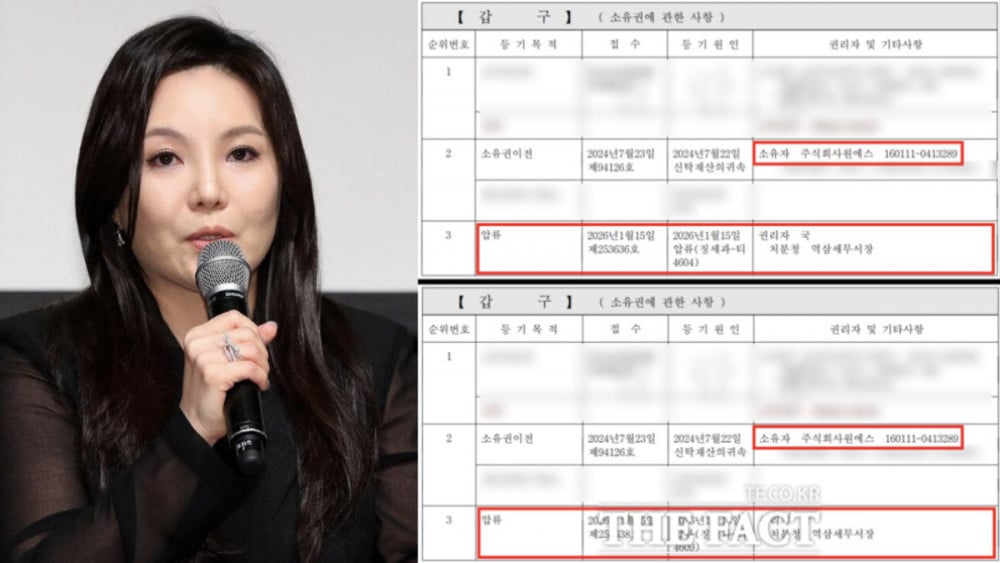
Cha Ga Won, chairman of One Hundred Label, is facing escalating financial and legal pressure after luxury villas he owns in Seoul were seized due to large unpaid taxes. The situation has raised growing concerns that artists Lee Seung Gi and Baekhyun may be exposed to serious financial risk tied to their high value jeonse contracts.
According to an investigation by The Fact on January 22, the National Tax Service, through its Yeoksam District Tax Office, seized one residential unit at La Nouvo Hannam Phase 1 on January 14 and 15. In addition, two units at La Nouvo Hannam Phase 2, owned by real estate firm One S, were also seized. Cha serves as an internal director of One S.
La Nouvo Phase 1 consists of four units, all jointly owned by Cha and her husband, identified as Mr. Park, with each holding a 50 percent stake. The tax authority seized Cha’s ownership share in one of those units. La Nouvo Phase 2 contains seven units, two of which are fully owned by One S and have now been seized by the tax authority.
A tax seizure indicates the government’s intent to enforce collection by selling the property to recover unpaid taxes. Appraisers have estimated the value of a single unit at La Nouvo Phase 1 to be approximately 10 billion KRW (about 7.5 million USD), while units at Phase 2 are valued at roughly 4.3 billion KRW each (about 3.2 million USD). The fact that multiple high-value units were seized suggests either long term or exceptionally large tax delinquencies.
One unit in La Nouvo Phase 2 had remained under One S ownership until early January, when ownership was transferred to Xiumin on January 9. That unit had previously been seized in July of last year and released in September. Less than five months later, two additional units were seized again, raising questions about repeated tax delinquencies.
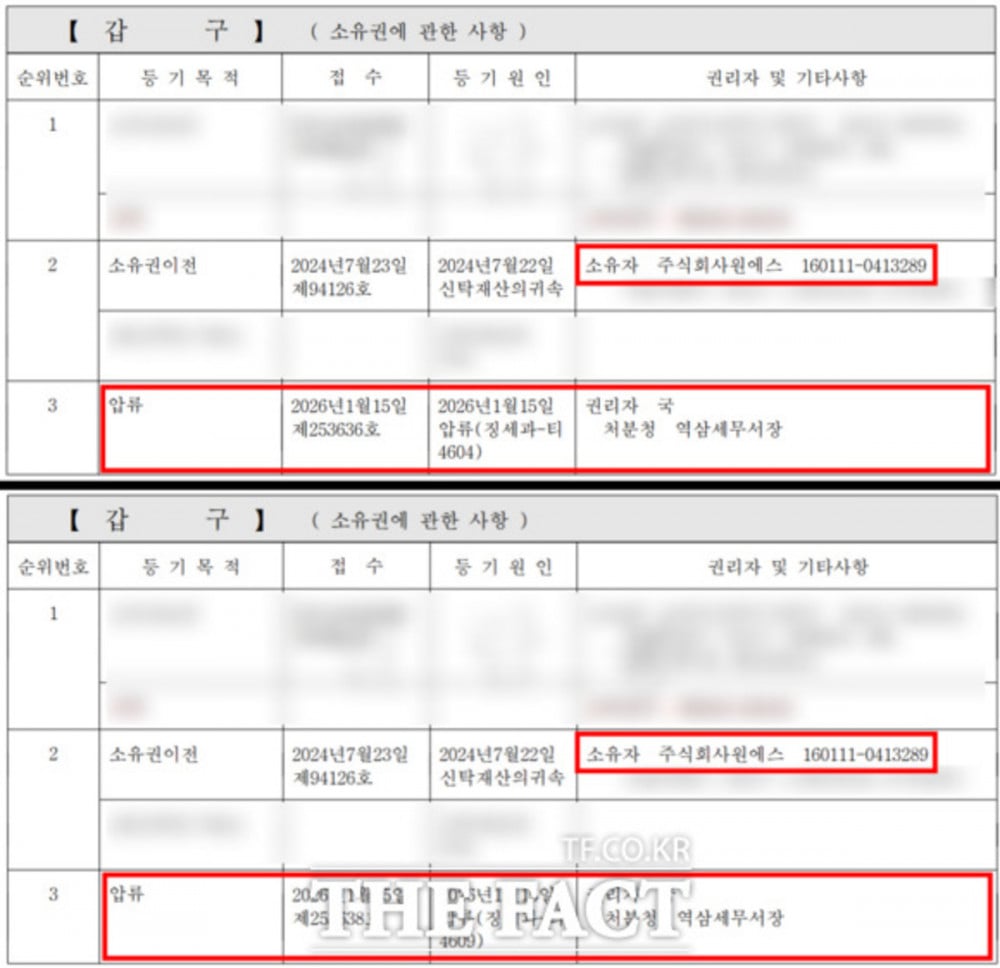
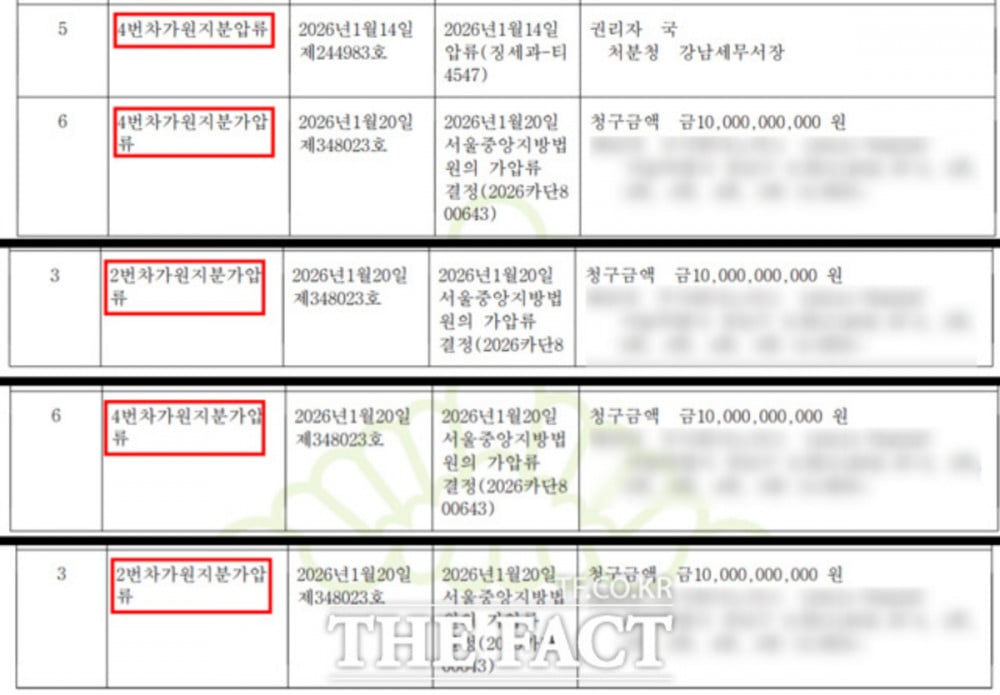
Cha’s difficulties extend beyond tax issues. A major domestic entertainment technology company, referred to as Company A, filed a provisional attachment request on all four units at La Nouvo Phase 1. The Seoul Central District Court approved the request on January 20. As a result, Cha is prohibited from exercising property rights over those units until the lawsuit is resolved.
Industry sources allege that Cha inflated the market value of the La Nouvo properties to secure large loans, which were then used to operate One Hundred Label and its affiliated agencies Big Planet Made and INB100. If these allegations are substantiated, the seizures and court-ordered attachments could severely impact the financial stability and operations of these companies.
Concerns are now mounting for artists and employees under these labels. Lee Seung Gi and Baekhyun are the representative artists of Big Planet Made and INB100, and both signed jeonse contracts at La Nouvo Phase 1. Lee’s contract was reportedly valued at 10.5 billion KRW (about 7.9 million USD), while Baekhyun’s reached 16 billion KRW (about 12 million USD).
At the time of signing, Lee and Baekhyun each took out loans in their own names. Lee borrowed approximately 7 billion KRW (about 5.2 million USD), while Baekhyun borrowed around 10 billion KRW (about 7.5 million USD). If the properties are auctioned following the legal proceedings, those loan obligations would remain with the two artists.
With all four units at La Nouvo Phase 1 now under provisional attachment, concerns that Lee Seung Gi and Baekhyun could be left as high-value debt holders are increasingly being viewed as a realistic possibility. The situation has also renewed scrutiny over reports of unpaid artist settlements and the potential for delayed or unpaid wages for company staff. Critics warn that any fallout from Cha’s alleged mismanagement may ultimately be borne by artists and employees rather than company leadership.
Previously, The Fact reported on January 16 that Cha was sued by Company A for alleged fraud under the Act on the Aggravated Punishment of Specific Economic Crimes, involving claims totaling approximately 10 billion KRW (about 7.5 million USD). The court’s recent provisional attachment decision is widely believed to be connected to that lawsuit.
As legal proceedings continue, the case is drawing significant attention within the entertainment industry, particularly amid broader concerns about financial transparency, artist protection, and structural risks associated with ultra-high-value jeonse contracts.
SEE ALSO: BREAKING Mark concludes his exclusive contract with SM Entertainment, leaves NCT
 SHARE
SHARE